APALPADOR 
Advancing the understanding on droughts and compound drought-heatwave large events in current and projected future climate via Lagrangian modelling of moisture and heat transport.
PIs: Raquel Nieto & Luis Gimeno (EPhysLab, University of Vigo, Ourense)
CALL: Ministerio de Ciencia e Innovación. Proyectos de Generación de Conocimiento 2024
REFERENCE: PID2024-155515NB-I00
BUDGET: 244.500 euros
PERIOD: september 2025 - august 2028
SUMMARY
Drought is regarded as one of the most pervasive natural disasters, impacting approximately 55 million individuals annually and precipitating profound socio-economic and environmental consequences. It is responsible for a greater number of human fatalities and displacement than any other natural hazard. The impact of drought events may be further exacerbated in a future climate. Droughts can occur as isolated phenomena or in combination with heat waves, multiplying the damage caused. These events tend to occur in combination (compound events), because both are often associated with similar atmospheric circulation anomalies and because they feed back on each other, since greater warming implies greater evaporative demand and intensifies drought conditions. Of all the compound events, drought-heat waves are undoubtedly the most destructive hazard, affecting human lives, ecosystems and economic. A number of dynamic factors can exert an influence on the occurrence of drought conditions, but now it is well established that the transport of moisture from oceanic sources to the continents plays a pivotal role in the occurrence of these events. In addition to deficits of precipitation there are also important thermodynamic mechanisms that affect drought severity, some of them directly through increasing air temperature.
Therefore, identifying regions with negative anomalies in the moisture support and regions with above normal contribution to elevated temperatures partitioned by different physical processes (advection, adiabatic and no adiabatic processes) are crucial steps for understanding the mechanisms of droughts, and especially concurrent droughts and heatwaves. Special emphasis must be placed on Europe, one of the regions most affected by the current and future climate. This is the central objective of this project.
The powerful Lagrangian methods for tracking moisture and heat, which will be used in this project, coupled with the augmented computational capabilities, permit the posing of questions about the occurrence of droughts and combined drought/heatwave events on a global scale and for future climates that have not been fully addressed, or not addressed at all by the scientific community.
The project will enable the extent to which the sources of moisture and heat deviate from climate normality in major episodes of these natural disasters at the global level and estimate how anomalous these deviations could be in a future climate for similar situations for the European region. Moreover, it will be possible to ascertain the extent to which deficits in moisture transport and the various contributions associated with diverse physical processes of temperature excesses (advection, adiabatic and nonadiabatic processes) that occur in a drought or in a combined drought-heat wave event influence the occurrence and development of these phenomena and to estimate whether this influence will be maintained in a changing climate. This will enable us to gain a deeper understanding of the underlying mechanisms of droughts, particularly in the context of concurrent droughts and heat waves, and their associated effects.
· Schematic illustration of the influences moisture and heat transport
on the occurrence of droughts and compound droughts and heatwaves events ·
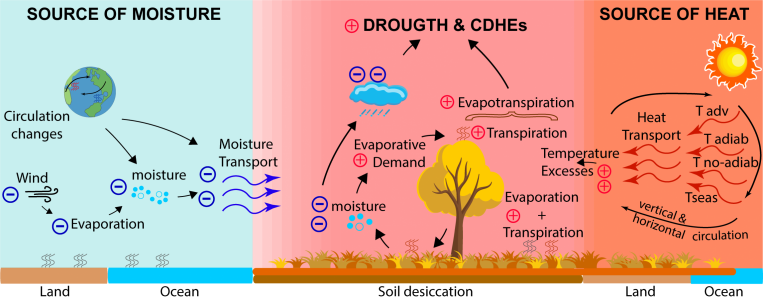
L. Gimeno, R. Nieto, J. Eiras-Barca, R. Sorí, M. Stojanovic, A. Pérez-Alarcón, J. C. Fernández-Álvarez, L. Gimeno-Sotelo, P. Coll-Hidalgo, G. Alvarez-Socorro, S.M. Vicente-Serrano (2026) Tracing atmospheric heat and moisture pathways to understand compound drought–heatwave events, Weather and Climate Extremes DOI: 10.1016/j.wace.2026.100923 [pdf]
APALPADOR project PID2024-155515NB-I00 is funded by the Ministerio de Ciencia, Innovación y Universidades, Spain (MICIU/AEI/10.13039/501100011033) and by “ERDF/EU”.
